
Contractor Website Conversion Essentials for 2026
How Contractors Can Turn Traffic Into Calls & Booked Jobs
Most contractors focus on SEO, PPC, or paid leads, but forget the one piece of the puzzle that determines whether any of that traffic turns into actual revenue:
Website conversions.
In 2026, contractor websites play a very different role than they did even a few years ago. Homeowners now expect:
- Instant answers
- Clear calls-to-action
- Trust signals up-front
- Mobile-first design
- AI-readable structure
- Fast load times
- A frictionless path from “searching” to “booking”
A contractor may outrank the competition, but if their website does not convert, they still lose the job.
This guide breaks down the conversion essentials contractors need in 2026 to turn website visitors into calls, form fills, and booked jobs.
The Goal of a Contractor Website in 2026: Remove Friction
Homeowners visit contractor websites for only three reasons:
✔ “Can you fix my problem?”
✔ “Do I trust you?”
✔ “How do I contact you?”
If your website doesn’t answer these questions immediately and clearly, you lose the lead.
The contractor websites that convert in 2026 all share one thing:
They remove friction at every step of the homeowner’s decision-making process.
Friction includes:
- confusing menus
- small text
- unclear services
- no pricing guidance
- lack of trust signals
- buried phone numbers
- vague CTAs
- broken or slow mobile layouts
Your website must eliminate all of it.
Put the Right CTA in the Right Place
Most contractor websites either:
- oversell (too many CTAs everywhere), or
- undersell (no clear CTA at all)
Neither converts well.
In 2026, the best converting contractor websites use a simple 2-CTA system:

Primary CTA:
“Request Service”
“Book Now”
“Schedule An Estimate”
“Call Now”
The primary CTA should appear in:
- header (persistent)
- hero section
- top-of-scroll
- bottom of each service page
- mobile sticky bar
Secondary CTA (less urgent):
“Get a Quote”
“Learn More”
“View Services”
The secondary CTA should appear in:
- blogs
- FAQ answers
- general educational pages
A simple CTA beats a clever one every time.
This is why it’s essential to align CTAs with the conversion-focused structure you describe to homeowners. See our full guide on Websites for Contractors for examples. Lead generation and conversion work together
Build Trust Fast — Homeowners Decide in Under 5 Seconds
By 2026, homeowners skim more than they read. They don’t scroll down to learn who you are. They decide whether to trust you almost instantly.
Your website must show:
✔ your value
✔ your legitimacy
✔ your credibility
…FAST.
The highest-converting contractor websites put the following ABOVE the fold (before scrolling):
Trust Signals (put these in your hero or top-third)
- 5-star review badges
- “Licensed & Insured”
- Years in business
- Service area coverage
- “Trusted by 5,000+ homeowners”
- Google Guaranteed badge (if applicable)
Even better:
Always link your service pages to your About page for deeper identity reinforcement: https://socialclimb.org/about/
Your About page plays a major role in contractor conversion psychology.
Make It Easy for Homeowners to Understand Your Services
Most contractor websites fail here. Homeowners don’t know:
- what the service includes
- what the process looks like
- what to expect
- how long it takes
- whether they need repair or replacement
- how urgent the issue is
And if they don’t understand → they don’t convert.
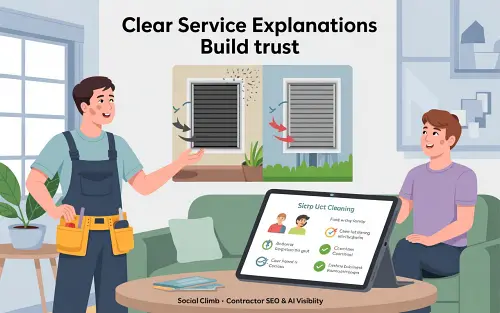
✔ The top converting service pages include:
- clear description
- what’s included
- symptoms homeowners notice
- before/after expectations
- simple pricing guidance (ranges are okay)
- photos or diagrams
- short FAQ section
For deeper local relevance, connect service content back to your Local SEO for Contractors pillar page, that reinforces geographic context and ranking relationships.
Show Homeowners the “Path to Work With You”
This is essential.
Websites in 2026 must clearly show the steps homeowners will experience.
For example:
A 3-step contractor process:
- Call or Schedule
- On-Site Assessment
- Repair / Service / Installation
Why this works:
Homeowners feel uncertain about hiring contractors.
A short, clear process removes ambiguity → increasing conversions.
Adding this near your CTA increases calls by 10–30% on average.
Optimize for Mobile — It Now Drives 75% of Contractor Traffic
In 2026, mobile is no longer “important.” It is the contractor website experience.
Your mobile site must:
- load in under 2.5 seconds
- have a sticky CTA bar
- have readable font sizes
- use tap-friendly buttons
- avoid intrusive popups
- have tight spacing
- make phone number clickable
- display reviews clearly
If your desktop site looks amazing but your mobile site is messy, your conversion rate will tank.
Google and AI engines also read mobile structure before desktop.
AI Search Engines Evaluate Website Content Structure

This is a major 2026 update.
AI systems like ChatGPT, Bing Copilot, Google AI Overviews and Perplexity analyze your:
- headings
- lists
- Q&A structure
- answer boxes
- clarity
- scannability
This determines whether you’re recommended as a good local contractor. Contractor websites must be optimized for AI readability, not just Google crawling. This is where your schema comes in.
Adding structured data boosts conversions AND AI visibility.
See our guide on How Schema Helps Local Businesses Rank.
Integrate FAQs Directly Into Your Website (Homeowners Love This)
Homeowners ask dozens of questions during emergencies. Your FAQ page at https://socialclimb.org/faqs/ should connect with:
- service pages
- blog posts
- pricing pages
- booking process
- warranties
- trust signals
Every time a homeowner finds the answer they’re looking for, they are more likely to convert.
Use Content Clusters to Support Conversions (2026 AEO Strategy)
Conversion isn’t just about pages — it’s about how all your website content works together. Your blog, service pages, and educational content must connect in a way that AI engines and Google understand.
This is why you created your SEO content pillar: https://socialclimb.org/local-seo/contractor-seo-content-strategy/
This content cluster supports conversions by:
- building authority
- explaining homeowner problems
- guiding users to solutions
- strengthening internal link maps
- helping AI systems classify your expertise
Add Soft Calls-to-Action in Every Blog Post
Blogs are not selling pages — they educate.
So the CTA must match the reader’s state of mind.
Examples:
- “Need help diagnosing this issue? Call us for an assessment.”
- “If you’re facing this problem, our team can help and provide an estimate.”
- “Serving Phoenix, Chandler, Tempe, and surrounding areas, request service today.”
A soft CTA does not interrupt the reader.
It guides them.
This boosts lead volume without making your content feel pushy.

Homeowners Trust Local Relevance (Critical for Conversions)
Your content should clearly indicate:
- where you serve
- which areas you specialize in
- local context
- seasonal relevance
- local regulations
- local weather patterns
This is one reason your Local SEO pillar page matters so much: https://socialclimb.org/local-seo/
Search engines and AI systems use local cues to determine whether you’re the right contractor for the job.
Website Conversion is Now Part of Local SEO (2026 Update)
In 2026, Google is using:
- bounce rate
- scroll depth
- dwell time
- engagement
- conversion actions
…as signals for local search rankings.
That’s right, conversions influence SEO. This is why website optimization, Local SEO, and AI search visibility must work together.
You can learn how AI search reacts to contractor content on: https://socialclimb.org/ai-search/
Your website experience directly affects:
- map rankings
- AI Overview recommendations
- ChatGPT local provider suggestions
- Perplexity citations
Website conversion is no longer “a nice to have.”
It is a ranking factor.
Final Thoughts: Conversion Is the Contractor’s Most Valuable Skill in 2026
A website that converts well:
✔ wastes zero traffic
✔ increases ROI of SEO
✔ boosts AI-driven visibility
✔ improves homeowner trust
✔ generates calls faster
✔ strengthens your entity
✔ increases booked jobs
Contractors who master conversion will outperform competitors — even those with bigger budgets.
If you’re ready to improve your website and turn more traffic into booked jobs, explore how our Websites for Contractors service can transform the way homeowners experience your business online.
Want to show up where homeowners search next?
Social Climb helps home-service contractors build real visibility across Google, map packs, AI Overviews, ChatGPT, Bing Copilot, and Perplexity. Whether you need stronger Local SEO, AI search visibility, better lead generation, or a contractor website that converts, we’ve got you covered.
Explore our contractor services:
• AI Search Visibility: https://socialclimb.org/ai-search/
• Local SEO for Contractors: https://socialclimb.org/local-seo/
• Lead Generation Systems: https://socialclimb.org/home-service-leads/
• Contractor Websites: https://socialclimb.org/websites-for-contractors/
If you ever need help turning searches into real booked jobs, we’re here.