
How a Simple Homepage Fix Increased Search Visibility 443% in 30 Days
A real-world SEO test showing how correcting core homepage signals helped a Denver tree service expand search visibility across the metro area, without backlinks, new pages, or ongoing SEO campaigns.
30-Day Search Visibility Results
| Metric | Before | After |
|---|---|---|
| Search Impressions | 410 | 2,230 |
| Geo-Modified Queries | 51 | 227 |
| Visibility Growth | — | +443% |
** This wasn’t a full SEO campaign.
Why We Ran This Test
Many contractor websites struggle to appear consistently in search results, even when they offer the exact services customers are searching for.
In many cases, the problem isn’t a lack of backlinks or content. The real issue is that Google doesn’t clearly understand the business.
When search engines can’t confidently identify:
what services a company provides
where those services are offered
how the website fits within a local market
Visibility in search results tends to remain limited.
This often leads businesses to invest in ongoing SEO campaigns, link building, or content strategies before addressing a much more fundamental issue: the core signals on the homepage that tell Google what the business actually is.
To explore how much impact those signals can have, we ran a simple visibility test on a local contractor website.
The goal was to determine whether correcting key homepage signals alone could expand how Google associates the site with relevant searches – without adding new pages, building backlinks, or launching a full SEO campaign.
The Test Setup
To understand how much impact core homepage signals can have on search visibility, we ran a controlled test on a tree service website targeting the Denver, Colorado market.
The goal was to isolate the effect of a homepage optimization by limiting all other SEO activity during the test period.
Test Parameters
Website type: Local service business (tree service)
Market: Denver metro area
Primary page optimized: Homepage only
Test duration: 30 days
What Was Not Done
To isolate the impact of correcting the homepage signals, the following activities were intentionally not performed during this test:
No backlinks were built
No new pages were created
No blog content was published
No link-building campaigns were run
No citation or directory submissions
No ongoing SEO campaign was implemented
No Google Business Profile optimization
This allowed us to observe how correcting the core signals on the homepage affected how Google associated the website with relevant searches.
By isolating the change to a single page, we could clearly measure whether improvements in search visibility were the result of better homepage signals rather than broader SEO activity.
Because this was a website-only test without a Google Business Profile, the visibility changes shown here reflect improvements in organic search interpretation alone.
Baseline Visibility
Before any optimization was performed, we established a baseline to understand how Google currently associated the website with search queries.
At this stage, the site had already been connected to Google Search Console, allowing us to observe the types of searches that triggered impressions.
Initial Search Visibility
At the beginning of the test period:
| Metric | Value |
|---|---|
| Search Impressions | 410 |
| Average Position | ~48 |
| Core Service Queries | 63 |
| Geo-Modified Queries | 51 |
An average position around 48 means the website was typically appearing on pages 4–6 of search results, where visibility and clicks are extremely limited.
While Google clearly recognized the site as related to tree services, its understanding of the local service area and specific service offerings was still limited.
Query Type Distribution
To better understand how Google interpreted the website, we categorized search queries into four groups:
• Core service queries
• Geo-modified queries
• Sub-service queries
• Irrelevant queries
This classification allowed us to track not only how many searches triggered impressions, but how Google interpreted the business itself.
For example:
Core service queries
tree services
Geo-modified queries
tree trimming lakewood co
tree removal westminster co
By monitoring how these categories changed over time, we could observe how Google’s understanding of the business evolved during the test.
Why This Baseline Matters
Before optimization, the website had limited search visibility and relatively shallow geographic association.
Although it appeared for some relevant searches, Google had not yet strongly connected the site with local service searches across the Denver metro area.
This baseline gave us a clear starting point to measure how homepage improvements would influence:
search impressions
geographic search visibility
query types associated with the website

The Homepage Optimization
With the baseline established, the next step was to improve how the homepage communicated the business to search engines.
The goal was not to add more content or launch a full SEO campaign. Instead, the focus was on clarifying the core signals that help Google understand what the business does and where it operates.
Several key elements on the homepage were refined to better align with how search engines interpret local service websites.
Service Identity Signals
The homepage was updated to clearly communicate the primary service offered by the business.
This included reinforcing the site’s association with searches related to:
tree trimming
tree removal
tree pruning
These signals help search engines understand the core category of the business.
Location Signals
The homepage also strengthened geographic signals by clearly identifying the primary service market.
This helps Google associate the website with local searches related to tree services in the Denver metro area.
Service Area Signals
A section of the homepage highlighted the surrounding cities served by the business.
This included locations such as:
Lakewood
Arvada
Westminster
Thornton
These signals help search engines understand that the business operates throughout the metro area rather than a single city.
Internal Location Links
Each of these cities linked to dedicated location pages.
This creates a clear structure that signals to search engines:
This type of internal structure helps search engines interpret how the business serves multiple locations within a region.
Why This Matters
Search engines rely on a combination of service signals, location signals, and internal page relationships to determine how a local business should appear in search results.
By clarifying these signals on the homepage, the goal was to help Google more confidently associate the website with local tree service searches across the Denver metro area.
Once those signals were strengthened, the next step was to observe how search visibility changed over the following weeks.
30-Day Results
After the homepage signals were corrected, we monitored how Google’s association with the website evolved over the next 30 days.
Because no additional SEO tactics were introduced during the test period, changes in visibility could be directly attributed to the homepage optimization.
Search Visibility Growth
One of the most immediate changes was the increase in overall search impressions.
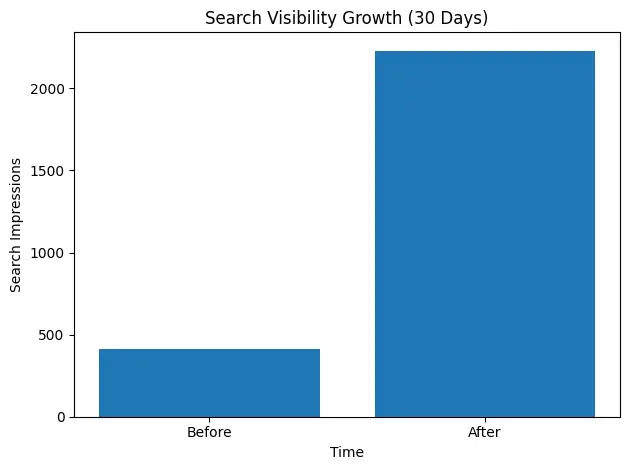
Search impressions increased from 410 to 2,230 within 30 days → a 443% increase in overall search visibility.
Search impressions measure how often a website appears in search results. While impressions do not guarantee clicks, they are a strong indicator that Google is beginning to associate the site with a wider range of relevant searches.
Expansion of Local Search Visibility
Another important change occurred in how Google associated the site with location-specific searches.
At the beginning of the test period, the website appeared for 51 geo-modified queries.
After 30 days, that number increased to:
227 geo-modified queries
These included searches related to tree services in surrounding cities such as:
Lakewood
Arvada
Westminster
Thornton
This expansion suggests that Google began interpreting the website as a regional service provider within the Denver metro area, rather than associating it with a limited set of generic service queries.
Early Ranking Movement
Along with the increase in search visibility, several keywords began moving into more competitive ranking positions.
Many queries that previously appeared in deeper search results began moving into the 20–40 position range.
For local SEO, this range often represents the stage where pages begin gaining enough visibility to move toward the first page of results.
While this test focused primarily on visibility expansion rather than immediate rankings, these early movements indicate that Google was beginning to evaluate the site more competitively for local searches.
How Google’s Understanding of the Website Changed
One of the most revealing insights from this test came from analyzing how Google categorized the search queries that triggered impressions for the website.
Rather than simply tracking rankings, we monitored how Google associated the website with different types of searches.
To do this, search queries were grouped into several categories:
Core service queries
Geo-modified queries
Sub-service queries
Irrelevant queries
This allowed us to observe not only how visibility changed, but how Google’s interpretation of the business evolved over time.
Query Distribution Before Optimization
At the beginning of the test, Google primarily associated the website with generic service queries.
| Query Type | Count |
|---|---|
| Core Service Queries | 63 |
| Geo-Modified Queries | 51 |
| Sub-Service Queries | 3 |
| Irrelevant Queries | 9 |
This distribution indicates that Google recognized the website as related to tree services, but its association with location-specific searches was still relatively limited.
Query Distribution After 30 Days
After the homepage optimization, the distribution of queries changed significantly.
| Query Type | Count |
|---|---|
| Core Service Queries | 6 |
| Geo-Modified Queries | 227 |
| Sub-Service Queries | 26 |
| Irrelevant Queries | 2 |
The most dramatic shift occurred in geo-modified queries, which increased from:
At the same time, generic core queries decreased significantly.
What This Means
This shift suggests that Google began interpreting the website less as a general tree service site and more as a local service provider operating throughout the Denver metro area.
Instead of appearing primarily for broad service searches such as:
tree services
The site began appearing for a much wider range of location-specific searches, including queries related to surrounding cities.
This change reflects a deeper level of confidence in how Google understands the service area and local relevance of the business.
Why This Matters for Local SEO
For local service businesses, visibility often depends on how well search engines connect a website with service-plus-location searches.
When Google clearly understands:
what services a business offers
where those services are available
it becomes far more likely to test that site across a wider geographic range of searches.
In this case, correcting the homepage signals helped shift Google’s interpretation toward a regional service provider, which led to a substantial increase in location-based search visibility.
What This Means for Local Businesses
This test highlights an important concept that many local businesses overlook when trying to improve search visibility.
In many cases, the biggest obstacle to ranking is not a lack of backlinks or content. Instead, it’s that search engines do not yet clearly understand what the business does and where it operates.
When those signals are unclear, websites may appear for some relevant searches, but their visibility tends to remain limited.
In this case, the website already had some search visibility before the test began. However, Google’s association with location-specific searches across the Denver metro area was relatively weak.
By improving how the homepage communicated the business’s services and service area, Google began to associate the website with a much wider range of local searches.
Within 30 days, this resulted in:
A 443% increase in search impressions
A significant expansion in geo-modified search queries
Early movement in ranking positions for several local keywords
Perhaps most importantly, Google began interpreting the site as a regional service provider rather than simply a general tree service website.
For local service businesses, this type of shift often forms the foundation for stronger rankings over time, because search engines are now more confident about when and where the website should appear in search results.
A Common Pattern in Local SEO
Many businesses attempt to improve rankings by immediately investing in link building, content marketing, or ongoing SEO campaigns.
While those strategies can be effective, they often work best after search engines clearly understand the business itself.
If the core signals on a website are unclear, additional SEO efforts may not produce the expected results.
By first correcting those foundational signals, it becomes much easier for search engines to connect the website with the searches that matter most.
The Key Takeaway
This case study demonstrates that even a focused homepage optimization can significantly expand how search engines associate a website with relevant searches.
Before investing heavily in long-term SEO campaigns, it’s often valuable to ensure that the fundamental signals on the website are clearly communicating the business’s services, location, and service area.
When those signals are aligned, search visibility can expand much more naturally, creating a stronger foundation for future rankings and growth.
Curious how your website is currently interpreted by Google?
Learn more about our Visibility Fix service.